Lighting Cabinet, Multi-channel LED, Daylight & Blackbody Simulator, Image Evaluation, Camera Calibration, Visual Assessment


 Thank You for Connecting with THOUSLITE at CIC34Thank you to every researcher, industry colleague and visitor who joined THOUSLITE during the CIC34 exhibition in Barcelona. Held on 4 and 5 November as part of the 34th Color and Imaging Conference, the exhibition gave us a valuable opportunity to learn together and exchange ideas. Your thoughtful questions and practical experience enriched our discussions on spectral lighting, visual assessment, individual colour matching and camera characterisation. Connecting conference ideas with experimental practice Organised by the Society for Imaging Science and Technology (IS&T), CIC34 takes place in Barcelona from 2 to 6 November 2026, with technical presentations at Universitat Pompeu Fabra’s Ciutadella Campus. The programme spans colour perception, image capture and reproduction, material appearance, lighting and multispectral imaging. The exhibition provided a welcoming setting to connect these research topics with experimental tools and practical requirements. The official programme includes contributions co-authored by Professor Ming Ronnier Luo on display viewing conditions, colour appearance and skin impressions. Learning about these topics alongside our conversations with visitors helped us explore how lighting conditions and research tools can support different experimental needs. Why spectral control matters Two light sources can have similar correlated colour temperatures yet different spectral power distributions (SPDs). Those differences can affect…2026-11-06
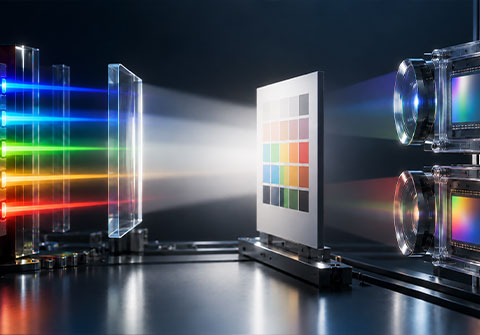 Why Do Colors Change When a Camera Sensor Changes?——What cross-sensor color constancy research reveals about algorithms, spectral control and consistent imagingConceptual illustration of controlled spectra, a test chart and different camera sensors. This is not a photograph of a THOUSLITE product or the apparatus used in the cited study. The same test chart, the same laboratory and apparently the same white light can still produce different color results when a camera sensor is replaced. For businesses seeking consistent imaging across camera models, production lines and suppliers, accurate white balance alone may not resolve the problem. Differences can begin as soon as light reaches the sensor. A study published online in Color Research & Application on 19 October 2026 explores cross-sensor color constancy. The researchers introduce physical image-formation constraints into model training to improve illuminant estimation for unfamiliar cameras without explicitly characterizing every target sensor. The work does not make hardware calibration redundant. It instead brings a fundamental question into focus: if the optical conditions in an imaging system cannot be described, what is the algorithm actually learning? Color Differences Begin Where Light Meets the Sensor An object surface does not have a fixed RGB value that a camera can read independently of illumination. The signal recorded in each color channel depends on the interaction between the illuminant’s spectral power distribution…2026-10-28
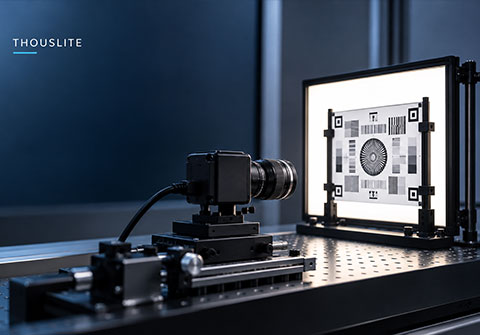 From Spectral Design to Imaging Validation——Building Reliable Lighting Conditions for Camera TestingOverview As spectral power distribution becomes a design variable, how can engineers ensure that lighting conditions are suitable for camera testing? THOUSLITE examines short-exposure imaging, HDR evaluation and color testing through three essential dimensions—spectral, spatial and temporal performance—and explains how measurement and documentation can make imaging results more comparable and reproducible. In our previous article, we explored how AI is opening new possibilities for spectral design. Here, we turn to the next challenge: once a spectrum can be designed, how do we verify that the resulting lighting conditions are fit for camera testing—and that the results can be reproduced and compared? Why might the same camera and test chart produce different color, noise or brightness results in two separate tests? Exposure, gain and image-processing settings are natural places to start troubleshooting. Yet another variable deserves equal attention: did the camera receive the same light in both tests? The spectrum, spatial distribution and temporal behavior of a light source all influence image formation. Measuring and documenting these conditions helps engineering teams isolate the causes of discrepancies and avoid repeated troubleshooting. 1 Standardized Testing Begins with Defined Lighting Conditions IEEE Std 2020-2024, the standard for automotive system image quality, was approved in…2026-10-15
 From Spectral Measurement to Spectral Design——AI-Driven Inverse Design Is Redefining Standardized Lighting EnvironmentsTraditional lighting design follows a familiar sequence: build the light source, then measure its spectrum. AI-driven inverse design reverses that logic: define the target spectrum first, then work backward to identify the optimal combination of parameters. As spectra shift from something measured after the fact to something deliberately designed, the way lighting environments are defined is undergoing a fundamental change. 1 A Paradigm Shift Already Underway Ask a lighting engineer how a spectrum is produced, and the traditional answer would usually be: select the LEDs, build a prototype, measure it with a spectrometer, and check whether the result is close to the target. If it falls short, revise the design and build another prototype. The cycle continues until the spectrum is close enough. This is a forward process: physical parameters come first, and the resulting spectrum follows. Now, an entirely different approach is emerging: inverse design. Instead of using available LEDs to approximate a target spectrum, engineers specify the target spectrum and ask an algorithm which LEDs to use, what drive currents to apply, and at what temperature to operate them. The spectrum becomes a design objective rather than simply a measurement result. A study published in Optics Express in…2026-10-09
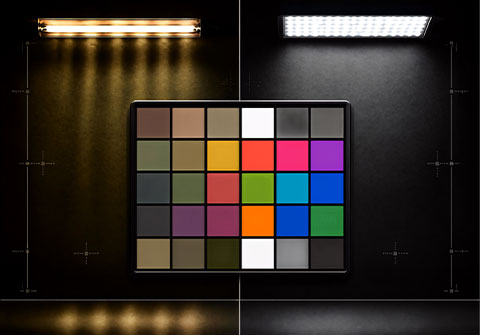 THOUSLITE Spectral Matrix Series · [Part One] Perception — The Shifting Ruler: Stop Paying the Hidden Cost of Color DeviationSpectrum as a Variable: The Digital Leap in Color Management — THOUSLITE Spectral Matrix Series — Introduction In an era where digital manufacturing and global supply chains are deeply intertwined, color is no longer a subjective perception. It has become a data asset that must be precisely measured, transmitted, and reproduced. Yet the limitations of conventional fixed-spectrum light sources are quietly introducing the risk of miscalibration at every stage of this data chain. The THOUSLITE Spectral Matrix Series aims to explore how multi-channel spectrally tunable LED technology is reshaping the underlying logic of color management — from recognizing deviation and building closed-loop workflows to real-world implementation. It provides a practical guide to spectral strategy for manufacturing enterprises, research institutions, and quality management professionals worldwide. Each article stands alone; together, the three form a complete framework to help you master spectral variables and establish a digital foundation for color management. The Hidden Cost of Color Deviation: Why Fixed-Spectrum Light Sources Have Become an Unreliable Baseline in the Data Era Conventional fixed-spectrum light sources are limited by non-tunable SPD, color temperature drift, and energy efficiency shortcomings. These issues cause systematic deviations in color evaluation across processes, making them among the most hidden…2026-09-18
 Color Isn’t Always What It Looks Like – How the LEDView Standard Light Booth Ends the Guesswork in Color EvaluationI. When Color Becomes Part of a Commercial Contract Color isn't always what it looks like. That's not a philosophical musing—it's a practical reality that manufacturing confronts every single day. Color is more than a visual phenomenon; in industry, it is a serious technical metric—a quality covenant that must be quantified, communicated, and traced. In the supply chains of international trade and high-end manufacturing, color assessment is never a subjective affair—it requires objectivity, not guesswork. Every shade standard document issued by a brand to its contract manufacturer carries the weight of a legally binding specification. Every delta E value recorded on a quality inspection report directly impacts batch release, payment settlement, and brand reputation. In this sense, color is quality—and quality is the baseline of delivery. Yet color remains one of the most challenging quality dimensions to control. The same formulation, the same roll of fabric, the same batch of molded parts can appear visually different under morning daylight versus afternoon sunlight. A product judged acceptable under one facility's lighting may be rejected for color deviation upon arrival at another brand's site. This is not a technical failure—it is a systemic discrepancy rooted in inconsistent lighting standards. At industrial scale, such discrepancies…2026-08-31
 Product Deep-Dive: Automotive Color Under Control – The LEDCube Spectrally Tunable Light Room SolutionFrom Fixed Illuminants to Programmable Spectra – Redefining Vehicle Appearance Quality Standards Introduction: Why Every Vehicle Deserves a Programmable Light Environment In today's automotive industry, color is far more than a design element—it is a critical quality metric. With the growing adoption of metallic finishes, pearlescent coatings, and eco-friendly waterborne paints, traditional fixed-color-temperature light sources like the D65 standard illuminant are no longer sufficient for rigorous quality control. "Why does the paint look flawless under the showroom lights, yet appear mismatched in the parking lot under sunlight?" This is a question that has long challenged OEMs, quality engineers, and color designers alike. In this article, we take a deep dive into the Thouslite LEDCube Any Lighting Scene Simulator —a professional-grade solution that delivers a truly precise spectral benchmark for automotive color calibration, exterior appearance inspection, and premium display applications. 1. Why Automotive Color Evaluation Demands a Professional Lighting Environment 1.1 Color Is the "First Language" of an Automotive Brand Studies show that consumers perceive brands in a specific order: color, shape, number, wording, and message—with color alone accounting for up to 80% of brand recognition. In the automotive space, the quality of a vehicle's paint finish directly shapes the buyer's first impression of…2026-07-18
 When Colors No Longer Play Tricks – THOUSLITE’s Spectrally Tunable Technology at IFCV 2026— A technical conversation on the essence of color perception – with gratitude to all who joined usFrom April 25 to 28, 2026, Beijing hosted the International Forum on Colour and Vision Science (IFCV 2026). THOUSLITE brought its spectrally tunable technology to the forefront, showcasing four core products – LEDCube, LEDView, LEDSSF, and LEDMax. Throughout the event, professionals from display, camera, automotive, textile, coatings, and research sectors engaged in deep technical discussions around key questions: “How can we fundamentally solve observer metamerism?”, “How do we trace a camera’s spectral sensitivity?”, and “Can a personalised colour matching function replace the CIE average?” This was more than a product exhibition – it was a thoughtful technical dialogue on the very nature of seeing. LEDCube – Any SPD Simulator: your personal “light lab” The spectral power distribution (SPD) of a light source directly determines the colour of an object under that source. Even two sources with the same correlated colour temperature can make the same object appear different if their spectral compositions differ. This is the physical root of metamerism. LEDCube is built on proprietary algorithms and uses more than a dozen carefully selected LEDs with different peak wavelengths to accurately match any SPD. Covering 350–1000 nm, it delivers CIE Ra>98 and Metamerism Index Grade A, with colour temperature tunable…2026-04-28
 Preserving Light and Shadow: How Spectrally Tunable LEDs Safeguard Global Art and Cultural HeritageLight. Protection. Challenges. Light is the medium through which art is brought to life, but improper illumination can also become a potential threat to cultural heritage. Research indicates that organic pigments—particularly red and yellow—are highly susceptible to fading or degradation when exposed to inappropriate lighting conditions, with significant damage occurring in just a few months. To combat this, leading museums around the world are increasingly adopting spectrally tunable LED lighting technology. Not only does this technology offer outstanding energy efficiency, but it also represents a breakthrough in precise spectral control: effectively filtering out harmful UV/IR radiation, regulating blue light levels, and delivering high CRI/R9, thereby creating a truly protective exhibition lighting environment. ↑Leading museums worldwide are gradually adopting spectrally tunable LED lighting technology to achieve a truly "protective exhibition" lighting environment. The Science Behind Spectral Control: Why It Matters The essence of cultural heritage lighting lies in balancing visual authenticity with minimal damage—a task that depends entirely on the precise regulation of the spectral power distribution (SPD): ● CRI & R9: Pigments such as crimson red or hemp yellow require high color fidelity. To ensure that artworks display rich, vibrant colors, international museums typically require a CRI ≥ 90…2025-08-25
 Precision in Color Management: How RAL Standards and CMF Design Influence Industrial Color?In the World of Color, Precision Matters More Than You Think! From smartphones and automobiles to architecture, home appliances, and medical equipment, color, material, and finish (CMF) design plays a crucial role in shaping our visual experiences. In industrial manufacturing, ensuring color consistency and stability is essential, as it directly impacts brand identity, product quality, and consumer purchasing decisions. But did you know? The same color can appear drastically different under different lighting conditions! This is why color standardization and precise control are critical in industrial design, brand marketing, and manufacturing processes. This necessity is at the heart of both RAL color standards and CMF design principles. As globally renowned color scientist Professor Ronnier Luo famously stated, "In our industry, color is everything." This statement is not just a motto for designers but a fundamental truth for all professionals involved in color management. How can we ensure that colors remain accurate and consistent across different lighting environments? A perfectly matched color in the lab might look completely different under store lighting, daylight, or office illumination, potentially leading to inconsistencies in product appearance and market perception. Addressing this challenge is the driving force behind advancements in color science—and the key topic…2025-02-10