Lighting Cabinet, Multi-channel LED, Daylight & Blackbody Simulator, Image Evaluation, Camera Calibration, Visual Assessment


Why Do Colors Change When a Camera Sensor Changes?——What cross-sensor color constancy research reveals about algorithms, spectral control and consistent imaging
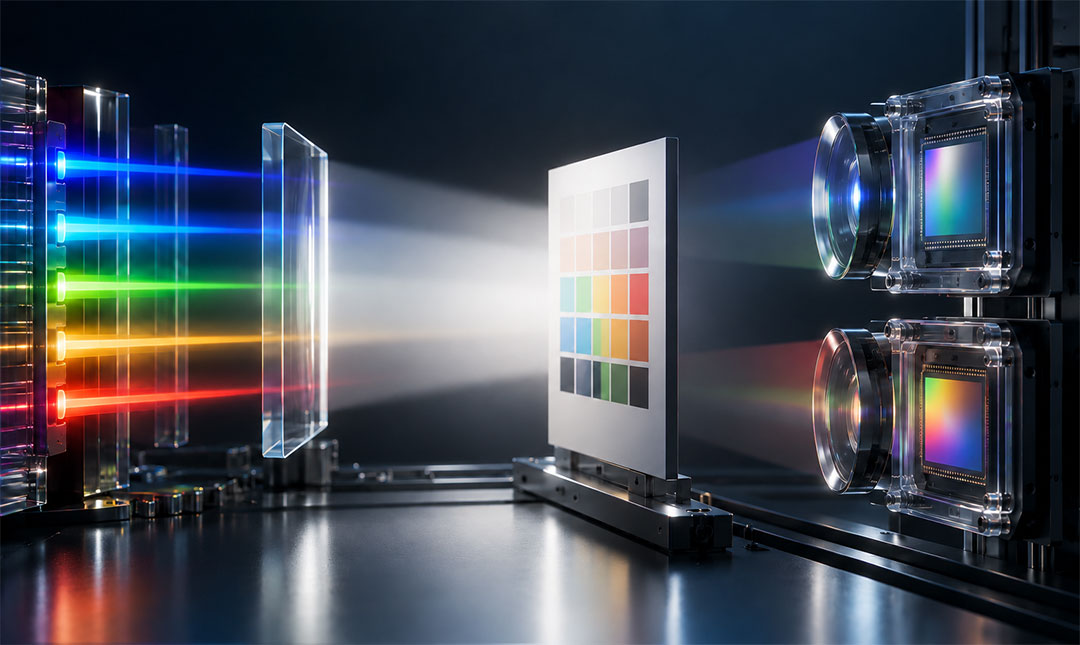
Conceptual illustration of controlled spectra, a test chart and different camera sensors. This is not a photograph of a THOUSLITE product or the apparatus used in the cited study.
The same test chart, the same laboratory and apparently the same white light can still produce different color results when a camera sensor is replaced. For businesses seeking consistent imaging across camera models, production lines and suppliers, accurate white balance alone may not resolve the problem. Differences can begin as soon as light reaches the sensor.
A study published online in Color Research & Application on 19 October 2026 explores cross-sensor color constancy. The researchers introduce physical image-formation constraints into model training to improve illuminant estimation for unfamiliar cameras without explicitly characterizing every target sensor. The work does not make hardware calibration redundant. It instead brings a fundamental question into focus: if the optical conditions in an imaging system cannot be described, what is the algorithm actually learning?
Color Differences Begin Where Light Meets the Sensor
An object surface does not have a fixed RGB value that a camera can read independently of illumination. The signal recorded in each color channel depends on the interaction between the illuminant’s spectral power distribution (SPD), the material’s spectral reflectance and the channel’s spectral sensitivity function (SSF). In simplified terms, the camera records the combined response to these spectral factors over the visible range rather than an intrinsic object color.
This explains why two cameras viewing the same scene can produce different raw channel values. Sensors differ in their color filters, pixel structures and photoelectric responses. Light sources described as D65, or with similar correlated color temperatures (CCTs), may also have different SPDs. For materials with strongly wavelength-dependent reflectance, small spectral differences can translate into visible color shifts that vary from one sensor to another.
Conventional white balance estimates scene illumination and adjusts channel responses to reduce many common color casts. It cannot recover spectral information that a sensor never recorded, nor can it guarantee consistent reproduction of every material across cameras. Color constancy is therefore a system-level problem involving the light source, sample and sensor as well as image processing.
Bringing Physical Relationships into Algorithm Training
Chong Li, Long Ma, Kaida Xiao and Changjun Li address this challenge in “Physically-Constrained Diagonal Manifolds for Cross-Sensor Color Constancy.” Illuminant estimation models trained on data from one sensor can lose accuracy when applied to another with a different spectral response.
Their training strategy uses the von Kries diagonal model as a physical constraint. It projects measured ground-truth illuminants onto a constrained diagonal manifold to generate structured illumination variations consistent with the image-formation model. This encourages the network to distinguish illumination-related factors from sensor-dependent characteristics while retaining a physically meaningful training structure.
Experiments on Cube+, INTEL-TAU and NUS-8 demonstrate improved cross-sensor generalization. These are algorithm evaluations on public datasets, not validation of long-term factory stability, sensor batch variation, complex mixed lighting or all material surfaces. The abstract does not establish a guaranteed industrial color-error reduction. The study’s contribution is a physically grounded training approach tested under defined dataset conditions.
Better Algorithms Need Better Descriptions of Test Lighting
As algorithms seek to separate illumination changes from sensor differences, development teams need to record these variables separately in their experiments. A lamp’s CCT setting does not fully describe the spectrum incident on a test chart. More informative records include measured SPD, illuminance, illumination uniformity, viewing or capture geometry, exposure and gain, the RAW processing pipeline and the spectral properties of the test samples.
The purpose is to answer a practical engineering question: when a camera module shows a color deviation, does it originate in the sensor response, illumination, lens and filter system, or downstream color matrices and white balance? Stable, reproducible test conditions allow comparisons to move from subjective image preferences toward identifying the variables responsible for measurable differences.
During development, teams can establish a baseline with an agreed reference illuminant, then extend testing to explicitly defined SPD conditions and observe changes in RAW responses and color-correction results. For materials at risk of metameric mismatch, samples and illuminants with different spectral characteristics can be more diagnostic than repeated adjustment of a single white point. Such multispectral testing is a configurable validation approach; whether it is needed, and how many conditions to use, depends on the application and error budget.
Different Lighting Roles in Research and Production Calibration
In camera module production, stable and uniform test illumination supports repeatable measurements and process consistency. THOUSLITE LEDPanel is designed for camera module and sensor calibration in production lines, offering configurable lighting conditions, uniform output and SDK integration within established test workflows. For investigations into the effects of different SPDs, LEDTrans provides spectral matching and test chart illumination. LEDCube supports reference daylight simulation, including D50, D65 and D75, and matching of specified SPDs for larger-scale spectral comparisons and research into standardized lighting environments.
These products provide controlled illumination conditions. They do not automatically deliver a cross-sensor color constancy algorithm, and the cited paper does not establish that THOUSLITE equipment was used in its experiments. System performance also depends on whether the target spectrum can be realized in the actual setup and geometry, whether the output is verified by measurement, and how the camera and algorithm perform together.
Viewing production lighting, laboratory spectral control and image algorithms as parts of one quality chain makes their roles clearer. Lighting provides a controlled input, measurement establishes a reliable record, and algorithms address imaging differences. The application’s color error, repeatability and stability provide the final basis for evaluation.
From Visual Agreement to Explainable Consistency
Cross-sensor color constancy research highlights an important direction for the industry. Model generalization matters, but it does not remove the need to understand physical conditions. A mature color-management process connects the source SPD, sensor SSF, sample reflectance and image-processing method, allowing the conditions behind a color judgment to be traced when necessary.
When color differences can be located within measurable and reproducible stages, standardized lighting takes on a broader role. It supports stable test results and provides a common basis for validating new algorithms, sensors and manufacturing processes.
Research Reference
Chong Li, Long Ma, Kaida Xiao and Changjun Li. “Physically-Constrained Diagonal Manifolds for Cross-Sensor Color Constancy.” Color Research & Application, 51(6), e70137. First published online 19 October 2026. https://doi.org/10.1002/col.70137
Build Camera Color Evaluation on Verifiable Lighting Conditions
If you are planning camera module calibration, standard test chart illumination or multispectral imaging research, contact the THOUSLITE technical team to discuss target SPDs, test geometry, illuminance and validation workflows. A traceable test foundation helps connect lighting control with imaging algorithms.
Technical enquiries: +86 0519-85289860
Email: sales@thouslite.com
Website: www.thouslite.com
About THOUSLITE
THOUSLITE develops multichannel LED spectral tuning and light-quality management technologies. Founded in 2014, the company applies spectrally tunable LED lighting to consumer and industrial markets, serving research institutions and businesses in more than 30 countries and regions.
With in-house electrical and optical laboratories and proprietary technologies, THOUSLITE contributes to international academic exchange and standardization activities in color science and spectral imaging. Its standardized lighting solutions support controlled, measurable and traceable conditions from laboratory research to industrial quality control.