Lighting Cabinet, Multi-channel LED, Daylight & Blackbody Simulator, Image Evaluation, Camera Calibration, Visual Assessment


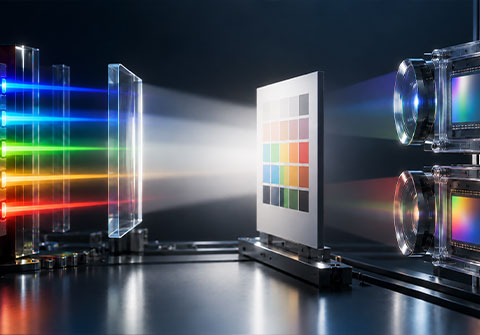 Why Do Colors Change When a Camera Sensor Changes?——What cross-sensor color constancy research reveals about algorithms, spectral control and consistent imagingConceptual illustration of controlled spectra, a test chart and different camera sensors. This is not a photograph of a THOUSLITE product or the apparatus used in the cited study. The same test chart, the same laboratory and apparently the same white light can still produce different color results when a camera sensor is replaced. For businesses seeking consistent imaging across camera models, production lines and suppliers, accurate white balance alone may not resolve the problem. Differences can begin as soon as light reaches the sensor. A study published online in Color Research & Application on 19 October 2026 explores cross-sensor color constancy. The researchers introduce physical image-formation constraints into model training to improve illuminant estimation for unfamiliar cameras without explicitly characterizing every target sensor. The work does not make hardware calibration redundant. It instead brings a fundamental question into focus: if the optical conditions in an imaging system cannot be described, what is the algorithm actually learning? Color Differences Begin Where Light Meets the Sensor An object surface does not have a fixed RGB value that a camera can read independently of illumination. The signal recorded in each color channel depends on the interaction between the illuminant’s spectral power distribution…2026-10-28
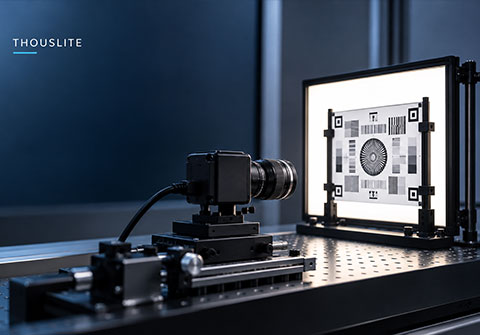 From Spectral Design to Imaging Validation——Building Reliable Lighting Conditions for Camera TestingOverview As spectral power distribution becomes a design variable, how can engineers ensure that lighting conditions are suitable for camera testing? THOUSLITE examines short-exposure imaging, HDR evaluation and color testing through three essential dimensions—spectral, spatial and temporal performance—and explains how measurement and documentation can make imaging results more comparable and reproducible. In our previous article, we explored how AI is opening new possibilities for spectral design. Here, we turn to the next challenge: once a spectrum can be designed, how do we verify that the resulting lighting conditions are fit for camera testing—and that the results can be reproduced and compared? Why might the same camera and test chart produce different color, noise or brightness results in two separate tests? Exposure, gain and image-processing settings are natural places to start troubleshooting. Yet another variable deserves equal attention: did the camera receive the same light in both tests? The spectrum, spatial distribution and temporal behavior of a light source all influence image formation. Measuring and documenting these conditions helps engineering teams isolate the causes of discrepancies and avoid repeated troubleshooting. 1 Standardized Testing Begins with Defined Lighting Conditions IEEE Std 2020-2024, the standard for automotive system image quality, was approved in…2026-10-15