Lighting Cabinet, Multi-channel LED, Daylight & Blackbody Simulator, Image Evaluation, Camera Calibration, Visual Assessment


From Spectral Design to Imaging Validation——Building Reliable Lighting Conditions for Camera Testing
Overview
As spectral power distribution becomes a design variable, how can engineers ensure that lighting conditions are suitable for camera testing? THOUSLITE examines short-exposure imaging, HDR evaluation and color testing through three essential dimensions—spectral, spatial and temporal performance—and explains how measurement and documentation can make imaging results more comparable and reproducible.
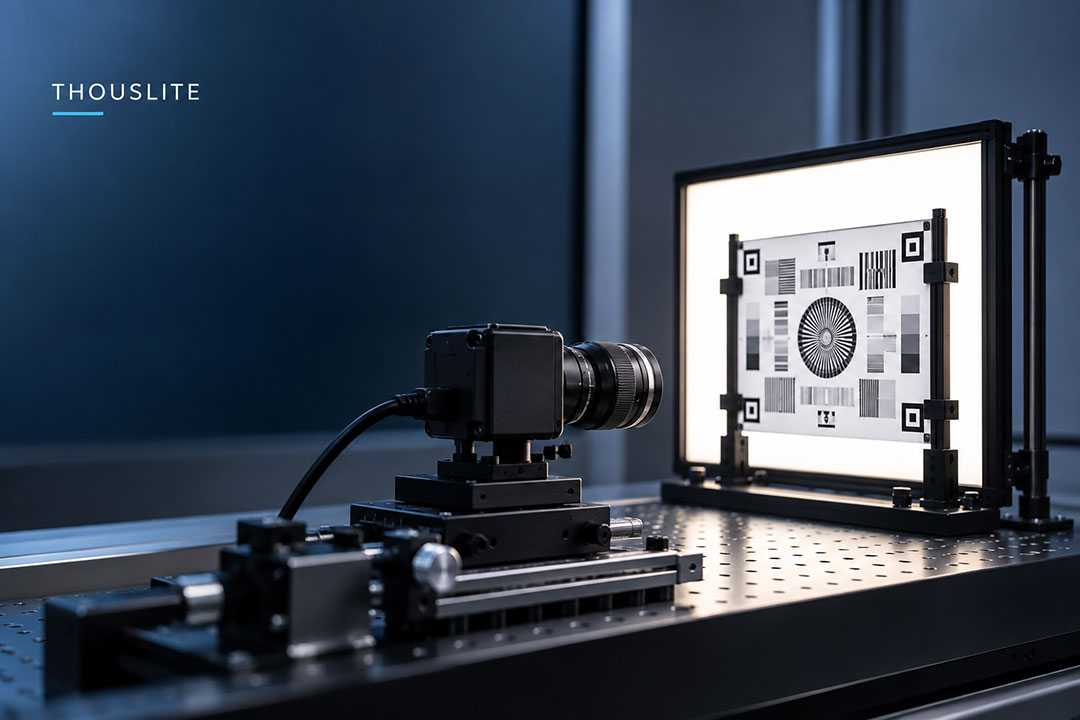
In our previous article, we explored how AI is opening new possibilities for spectral design. Here, we turn to the next challenge: once a spectrum can be designed, how do we verify that the resulting lighting conditions are fit for camera testing—and that the results can be reproduced and compared?
Why might the same camera and test chart produce different color, noise or brightness results in two separate tests? Exposure, gain and image-processing settings are natural places to start troubleshooting. Yet another variable deserves equal attention: did the camera receive the same light in both tests? The spectrum, spatial distribution and temporal behavior of a light source all influence image formation. Measuring and documenting these conditions helps engineering teams isolate the causes of discrepancies and avoid repeated troubleshooting.
1 Standardized Testing Begins with Defined Lighting Conditions
IEEE Std 2020-2024, the standard for automotive system image quality, was approved in December 2024 and published on March 21, 2025. Its public description emphasizes objective test methods and a common basis for discussing image quality among vehicle manufacturers, system integrators and component suppliers. For engineers, a test image or quality score is meaningful only when the conditions under which it was obtained are understood. Short-exposure testing depends on the light delivered during the exposure window. HDR evaluation depends on the actual luminance levels and contrast across bright and dark regions. Temporal-modulation testing requires a defined pattern of light variation over time. Each task calls for a different set of lighting conditions.
2 Short Exposures Demand Stability Within the Exposure Window
A camera integrates light during exposure. If the source output changes over time, two exposure windows can capture different signals even when the long-term average output is similar. At shorter exposure times, or with a rolling shutter, temporal fluctuations may appear as frame-to-frame variation or banding. Whether these artifacts occur depends on the light waveform, exposure duration, sensor readout method and their relative timing.
Lighting that appears steady to the eye therefore still needs to be evaluated under the intended exposure conditions. Validation should examine both temporal light output and the resulting images, using instruments with sufficient measurement bandwidth and sampling rate. Exposure, gain and automatic processing functions should also be fixed and documented as required by the test method.
3 Color Testing Requires More Than Color Temperature
Correlated color temperature (CCT) is a useful description of the apparent color of light, but it does not uniquely define its spectral power distribution (SPD)—the distribution of optical power across wavelengths. Two sources with similar CCT values can have substantially different spectral content. After interaction with a reflective object or transmission through a test chart, those differences can affect the signals recorded by individual camera channels and, consequently, the reproduced colors. Comparisons of white balance, color reproduction and cross-device calibration should therefore consider the illumination spectrum, sample properties and camera response together.
Multi-channel LED technology offers greater flexibility in shaping spectra. Whether a particular target SPD can be reproduced accurately, however, depends on the channel configuration, available output range and spectral matching error—and must be confirmed through measurement.
4 HDR Evaluation Must Verify the Scene’s Luminance Relationships
HDR assessment concerns bright regions, dark regions and the relationship between them. The maximum output of a light source alone does not establish the dynamic range of a complete test scene. Illuminance and luminance must be distinguished. Illuminance, measured in lux, describes light incident on a surface; luminance, measured in cd/m², describes light emitted or reflected by a surface in a given direction. Each must be measured at the locations specified by the test method. For illuminated panels and transmissive test charts, background conditions, stray light, optical construction and lens flare can also influence dark-region performance and effective contrast.
High spatial uniformity and high dynamic contrast are different design objectives. Uniformity supports consistent illumination across a defined area; dynamic contrast generally requires the creation and verification of different luminance levels within a scene. Test-chart illumination, uniform-field calibration and HDR scene evaluation should therefore be configured for their respective purposes. None can be characterized adequately by a single maximum-output figure.
5 Stable Illumination and Active Temporal Modulation Serve Different Purposes
Stable illumination aims to minimize light-source variation as a source of uncertainty in camera measurements. Active temporal modulation deliberately varies light output to investigate camera responses to specified frequencies, waveforms and timing relationships. These functions are not interchangeable. The ability to program a sequence of lighting states and their durations does not, by itself, demonstrate validated flicker waveforms, modulation depth or camera synchronization capability. The right approach is to define the test objective first, then establish which lighting and measurement capabilities are required.
6 THOUSLITE Solutions for Camera Calibration and Test-Chart Illumination
THOUSLITE specializes in multi-channel LED lighting and light-quality management. For camera and sensor applications, product capabilities should be assessed in the context of their intended use, control architecture and verified performance.
LEDPanel for Production-Line Calibration
LEDPanel is designed for production-line calibration of camera modules and sensors. According to the product information, the hardware can store 80 lighting presets. Used with LEDNavigator and a spectroradiometric illuminance meter, it supports measurement, resetting and calibration, while an SDK enables integration into customer software. These features support the repeatable selection of lighting conditions and integration into automated workflows. Output performance and acceptance criteria should be confirmed for the specific model and project.
LEDTrans for Transmissive Test-Chart Illumination
LEDTrans supports test-chart illumination and camera calibration. Published specifications describe multi-channel LEDs with amplitude-modulated drive, a 280 × 210 mm emitting area, uniformity greater than 96% across that area, and illuminance of up to 18,000 lux at the emitting surface. LEDNavigator-LT supports spectral matching, alongside external spectroradiometric feedback and SDK integration. These figures describe performance at the light-emitting surface. They should not be interpreted as the luminance behind a test chart, the amount of light reaching the camera, or the performance of a complete HDR test scene. Real-world validation must also account for chart transmittance, geometry and camera settings. Spectral tunability expands the available choices; measurement and calibration turn those choices into repeatable engineering conditions.
7 Complete Test Records Make Results Reproducible
Each test should be accompanied by a record of its key conditions. This makes it easier to determine whether a setup remains consistent when equipment, operators or test locations change. Spectral conditions: target and measured SPD, CCT and light-source settings. Spatial conditions: measurement positions, distances, effective illuminated area and the method used to assess uniformity. Output conditions: illuminance or luminance, measurement instruments and measurement time.
Temporal conditions: exposure time, frame rate and shutter mode; record the light-output waveform when relevant. System conditions: gain, white balance, HDR mode and image-processing settings. Reproducibility conditions: equipment models, configurations, ambient temperature and calibration records. These items provide a practical starting point for engineering documentation. Tests conducted to a particular standard must also include any additional records required by that standard.
When lighting conditions are traceable, teams can more confidently determine whether a change originates in the camera, the sample, the processing algorithm or the illumination itself. Reliable camera evaluation begins with reliable lighting conditions. Through multi-channel LED technology and light-quality management, THOUSLITE provides configurable lighting tools for camera-module calibration, test-chart illumination and imaging experiments. Performance boundaries should be established through measurement, with documentation and calibration supporting reproducible results.
Make Your Camera-Test Lighting Conditions More Reliable
Reliable imaging validation starts with clearly defined illumination. If you are developing a camera-module calibration process, a test-chart illumination setup or an imaging evaluation workflow, share your exposure times, spectral requirements, effective illumination area and software-interface needs with THOUSLITE. Our technical team can help clarify the test objectives and assess appropriate lighting configurations and verification methods—so results are easier to compare across batches and devices.
☎ Phone: +86 0519-85289860
✉ Email: sales@thouslite.com
⌂ Website: www.thouslite.com
About THOUSLITE
Founded in 2014, THOUSLITE is an innovative technology company specializing in multi-channel, full-spectrum tunable LED lighting and light-quality management. Serving customers in more than 30 countries and regions, we bring advanced spectral-tuning technology to consumer and industrial applications, working with internationally recognized research institutions and leading businesses.
As an early innovator in multi-channel spectrally tunable LED technology, THOUSLITE maintains in-house electrical and optical R&D laboratories and a portfolio of proprietary intellectual property. We participate in international academic conferences and standardization activities, contributing to progress in color science, spectral imaging and related methods. From research laboratories to production-line quality control, we develop precise, stable and traceable standardized lighting environments to help customers achieve demanding light-quality objectives.
Light, Engineered for Precision.